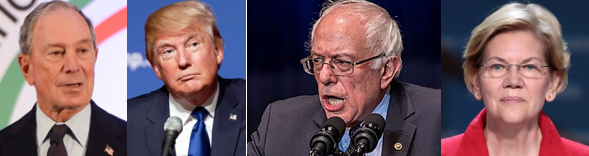
Bloomberg as Trojan Horse
Should the Democratic establishment think nominating Bloomberg will not only defeat Trump but also help preserve its control over the party, Democratic leaders may be in for a nasty surprise. In their minds Bloomberg may be a stone that can kill two birds (Trump and Sanders) but Bloomberg’s actions are also those of a corporate raider engaged in a hostile take-over bid of a company faced with implacable competition (the GOP) and burdened with a sclerotic, inept management (the DNC) and falling stock price (after the failed attempt to remove Trump and the Iowa caucus fiasco), and over which frustrated employees (liberals and progressives) now wish to assume ownership. The exclusive focus on removing Trump may have come at the cost of neglecting many substantive issues that mobilize voters and left the door open to the former Republican billionaire whose main political asset is an assumed ability to beat Trump next fall.
As nominee, Bloomberg with his money, media empire, and vast pool of political operatives and grateful political beneficiaries would be well poised to re-make the Democratic Party in his own image (by replacing management, firing troublesome employees, and appealing to stockholders/donors). Or he could simply destroy it all together and found — like that other media tycoon Silvio Berlusconi in Italy — his very own party on its ruins that owes loyalty to him and to him alone. There is also a parallel with French President Emmanuel Macron, a former banker. His economic austerity policies while Minister of Finance destroyed Socialist François Hollande’s presidency and precipitated the final decline of the French Socialist Party, opening a space for the creation of his very personal probusiness Republic on the March Party that swept to power in 2017.
Déjà Vu
In many ways, we have been here before — as Republicans well know. Trump’s successful bid to become the nominee of the Republican Party in 2016 was itself a textbook raid on a corporation that had been memorably dramatized in the public’s mind by Michael Douglas as corporate raider Gordon Gekko in Oliver Stone’s 1987 film Wall Street. Trump appealed to the shareholders (the GOP base) to revolt against a smug and incompetent management (the Republican establishment) by promising a price that could not be beat: unalloyed expression of their voter outrage at the status quo in a bid “to make [white] America great again.” After their humiliating rout, GOP leaders and conservatives alike still held out the hope that the party and later on the Oval Office would transform Trump, but instead he transformed them concentrating all political power in his person.
Bloomberg’s candidacy is no idle threat. Like any successful businessman and entrepreneur, Bloomberg expects a return on his investment, even in the event that his Presidential gambit should fail. It would be naïve to think otherwise, especially given the vast sums he has already committed to the campaign (over $400M and counting). To underestimate Bloomberg’s ambitions and his ability to carry them out could prove fatal as it was with Trump in 2016. Even to this day, four years later, Democrats still refuse to take seriously Trump’s sharp political instincts while preferring to focus on his violent, dysfunctional character, chaotic governing style, vulgarity, and lack of education. Bloomberg’s more varnished style is very different and enjoyed success in appealing to urban Democratic elites during his three terms as Republican mayor. He is now taking those lessons learned in New York to the political stage nationwide and to a national party far more liberal than he is or the Republican Party he once belonged to.
Trump and Bloomberg: Savior CEOs as American Folk Heroes
There is much that Bloomberg and Trump share in the way of political authority afforded by their private-sector careers. Both are contemporary icons of fame, wealth, and business success. Both are products of the go-go 1980s and 1990s in New York that celebrated the magic of the marketplace and oversaw the financialization of the economy that traded long-term direct investment in capital improvements (machines, buildings, etc.), employee training, and workers’ wages so to increase productivity and output, for higher returns on costly debt-financed non-productive investments — stocks, bonds, unregulated exotic derivatives (so-called ”shadow finance”), speculative real estate ventures, and massive corporate mergers. The resulting financial pressures in turn led to the offshoring of companies, factory closings, massive layoffs of workers, downsizing of middle managers, and the raiding of employee pension funds. It also gave rise to ruthless short-term management and its new creature, the tyrannical, bullying boss or CEO.
A new American folk hero was born whose harsh methods were afforded every indulgence and every reprieve by an admiring business press. “Savior CEOs” were deemed to be the solution to all the ills of the private and public sectors alike. Flourishing in this brave new world Bloomberg and Trump have enjoyed the enviable clout and freedom of the independent businessman who owns privately held family enterprises and owes no accountability to boards of directors or aggressive mutual fund managers, and thus is politically his own man beholden to no one (clan, party, or donors). In an age still in thrall to the gospel of the free market and individual material success, they share a belligerent sense of political entitlement, and, by virtue of their business personas, they each have promised to get things done and save us from the dysfunctions of government by introducing private-sector forms of management and privatizing government services. In their case top-down executive control with no accountability was deemed a political asset, not a liability, let alone a danger. They parlayed business success into new forms of political authority.
Different Animals
But there the resemblance ends. Today within the world of unfettered capitalism they stand as almost polar opposites of each other as chief executives. A real estate mogul from New York City’s outer boroughs (Brooklyn and Queens), Trump is more a dealmaker than a manager, and affects none of the smooth talk of corporate communications but all the rough street speech of under-socialized Wall Street bond traders and the outsized personality of free-wheeling entrepreneurs. Managing a large bureaucratic corporate enterprise does not interest him. Rather, for Trump action and movement are everything; like Gekko he radiates the pure macho energy of risk and success. The original tabloid businessman turned politician, whose tumultuous business dealings (3,500 lawsuits) and private life (two divorces, countless girlfriends) fill the scandal sheets, Trump is the pure entrepreneurial subject that still fascinates large segments of the public in our new Gilded Age. That is the basis of much of his public authority.
Boston-born and Harvard-educated Bloomberg, on the other hand, has his rough edges but resembles more the disciplined senior executive who oversees day-to-day operations of a large corporation and rationally manages long-term investment strategies of a portfolio of immense wealth. Unlike Trump, he was not born to wealth — he is the mythical self-made man of humble origins. His personal fortune may be over fifteen times larger than Trump’s but paradoxically he cuts a lower profile. The spectacle of his persona and private life is more modest. His is one of the earned authority of firm, steady competence in business and politics backed by a harsh, autocratic manner.
Even the late investigative Village Voice reporter Wayne Barrett, a thorn in both men’s sides throughout much of their careers, admitted in a lengthy 2008 article detailing Bloomberg’s successful corruption of New York City’s political process to run for an unprecedented third term as mayor that at first “Some of us liked him precisely because his wealth insulated him from the kind of [political] horse-trading that diminished his predecessors.” By contrast, Trump’s spectacle is one of vulgar glitz and glamour. It potently mixes the extreme personalization of power with the enviable freedom and irresponsibility of media and Hollywood celebrities trailed by more than a whiff of notoriety and scandal while nonetheless displaying the savvy worldliness of the makers and shakers of capitalist America.
Outside of New York, Bloomberg enjoys a powerful but more subtle presence and name recognition via the ubiquitous Bloomberg News and Bloomberg terminals, the Bloomberg app on smartphones, unparalleled philanthropic giving, non-profit organizations and research centers bearing his name, and a deep network of grateful beneficiaries. Prior to entering the Oval Office, Trump’s aura had always derived from grandiose real estate projects and lavish lifestyle promoted by celebrity reporting, reality TV, and an overwhelming social media persona. These translated unto an unprecedented ability to bypass traditional communication outlets controlled by political and economic elites. However, unlike Bloomberg, philanthropic actions do not figure in his portfolio. Rather than “giving back to the community” from which he has taken, Trump continues to take, and to take. Openly acknowledged self-interest and defiant violent behavior are features of his brand — much to the delight of many of his angry followers tired of establishment hypocrisy.
The Gang That Can’t Shoot Straight
Donald Trump’s electoral victory in 2016 left the Democratic party and its allies demoralized. However, outside the party proper, progressives and liberals did rebound quickly creating new activist groups like Indivisible.com, Sister District Project, and Swing Left. They joined already existing groups and movements like Black Lives Matter, #MeToo, and others to take back the House in the 2018 elections — which they did but with little acknowledgment by the mainstream press. That said, it must be noted that since 2016 the Democratic Party leadership has stumbled badly. First was the catastrophic mishandling of the Brett Kavanaugh Supreme Court hearings. This was followed by squandering the precious political capital acquired by the Blue Wave’s spectacular congressional success in 2018 on the Mueller investigation that bore no political fruit after three years’ worth of breathless public discussion and speculation of Trump’s conspiring with Russian electoral meddling. Finally, there was the bid to impeach and remove Trump (strongly advocated by the youngest and most progressive members of Congress) that failed to turn public opinion against the current occupant of the White House. (Arguably, the whole endeavor was doomed from the start to anyone with a political memory and an appreciation for current Republican Party discipline under Trump.)
Trump as Political Focus
The almost exclusive focus on removing Trump from office perhaps came at the cost of substantive discussion other issues that voters care about passionately, such as such as Medicare for All, immigration reform, student debt, gun control, college tuition, climate change, etc. They were the core of the House bill HR1 that was introduced by Nancy Pelosi to much fanfare in January 2019 but has not been heard from much since. Despite the House impeachment and Senate trial that did no damage to Trump’s approval rating, leaders of one of the leading new activist groups, Indivisible.com, has decreed the focus of their fall election strategy will be holding Republican senators who are up for re-election accountable for their vote to acquit Trump.
In the end Democrats’ focus on removing Trump as the only substantive issue created an opening for the former Republican mayor of New York whose key qualification is the presumed power to defeat Trump with his vast resources and whose platform addresses little in the way of Democrats’ concerns beyond gun control and perhaps climate change. As for the power of the purse to craft budgetary priorities afforded by their new majority in the House, Democrats took little advantage of it to rein in Trump’s actions including initiating military action abroad and the unlimited surveillance powers of the executive branch.
Trump has emerged from an extraordinary constitutional crisis and Democratic missteps stronger than ever (his approval rating has risen several points to an all-time high of 49% among registered voters according to the last two Gallup Polls). An outside observer might legitimately wonder whether Trump, following proven methods of street toughs, hasn’t all along provoked Democrats into fights he instinctually knew they couldn’t win in order to make them look hapless and weak in the public eye. This would be a fatal flaw in the current harsh, take no prisoners political environment. Beneath Trump’s reckless behavior may lie a Machiavellian mind.
Sanders’ Success and Bloomberg as Plan B
Finally, the early caucuses and primaries have been disappointing for centrist Democrats and their network of donors, think tanks, and sympathetic pundits: the Iowa Democratic Party revealed itself to be laughably incompetent, and the inept maneuvering of Tom Perez, chair of the DNC, around on-going primaries and the upcoming summer convention has managed to alienate liberal and progressive Democrats. Worse still, when they weren’t looking, Bernie Sanders’s campaign, studiously ignored by CNN and NBC/MSNBC, has unexpectedly surged demonstrating a broad appeal in a 26-point win in Nevada that caught party elders unawares. Meanwhile, Obama’s former Vice-President Joe Biden, visibly mentally diminished, has failed to gain momentum. Nationwide and swing state polls now indicate that Biden doesn’t perform markedly better than his rivals against Trump and in some polls he performs worse. “Electability,” long a club with which to promote safe, centrist candidates against insurgent progressives and to bludgeon Sanders and his supporters, has lost its some of its potency as an argument against progressive candidates. That the party establishment seems to have no Plan B for a viable alternate candidate of their liking from within their own ranks is a sign of a mounting sclerosis that has gripped its upper echelons. That same outside observer might be tempted to interpret their actions to mean that they are devoting more energies to controlling the party than to winning the fall elections.
Still, upon reflection, perhaps Mike Bloomberg has been the Party establishment’s unstated Plan B all along. After all, he was featured speaker at the 2016 Democratic convention in Philadelphia where, his voice dripping with sarcasm, he declared Trump a failed businessman. (The charge failed to move public opinion.) That was his first opening extended by party officials. He followed up by committing in 2018 $100 million to Democratic candidates for Congress. And in February 2020 the DNC was more than happy to relax its rules for the televised primary debates, which they had refused to do prior for other candidates, allowing him to participate in the debate two days before the Nevada primary in which he wasn’t running.
The Nevada Debate Fiasco
That Bloomberg’s debut debate was something of a disaster may give party leaders pause: eviscerated by Elizabeth Warren for racist and sexist remarks and policies, he struck viewers as ill-prepared to answer aggressive criticism of his record and public statements. What’s more, on the eve of the debate the attempt by the Bloomberg campaign to bully Joe Biden, Pete Buttigieg, and Amy Klobuchar by releasing a memo calling them to step aside and cease campaigning clearly antagonized them and opened a potential deep split between Bloomberg and segments of the party leadership. To all appearances he overplayed his hand: the high pressure tactics that worked well when he was mayor of New York boomeranged on the national stage. It’s also worth noting that beyond intimidating reporting of Bloomberg’s $400M juggernaut, Bloomberg hasn’t received much positive press from mainstream media that has been subjecting his political record and philanthropic activity to close scrutiny after years of neglect. This may have to do with the fact that they are worried that that with his matchless resources he, like Trump but for different reasons, will be able to simply bypass them via his vast ad campaign: no press conferences, no off-the record interviews, no personal profiles. Still, up to the time of the debate Bloomberg accumulated Democratic endorsements including from many politicians of color that make him a serious contender: 16 U.S. congressional representatives, 9 mayors including London Breed of San Francisco and Sylvester Turner of Houston, and 5 DNC members.
Beware of CEOs Bearing Gifts
At present there are no clear polling data indicating that Bloomberg surpasses other candidates in terms of his ability to beat Trump. Confident claims to his electability seem to ride on the aura of his unexamined record as a three-term mayor of New York and of his vast wealth. Clearer, perhaps, is the effect of a Bloomberg Democratic nomination, most likely by a brokered convention: by reneging on what remains of the Democratic Party’s historical identity as the party of the middle and working classes and the poor, it would effectively destroy the progressive Warren/Sanders wing of the party. In particular it would put Bernie Sanders in the impossible position of choosing between his longstanding populist commitments and supporting a billionaire who is the world’s fourteenth richest man with a poor record of social policies and respectful treatment of less-privileged citizens and residents Thus, in this scenario, if Sanders remains faithful to his political values, he effectively destroys whatever leverage he has enjoyed in the Democratic Party and confirms accusations made by its establishment that he is no true Democrat and cannot be trusted; if he supports Bloomberg, then he undoes his entire political career and betrays the millions who have supported him. The very starkness of the choice leaves little room to cut a political deal that saves face and promotes a progressive agenda, unlike in 2016 when Sanders was able to leverage his primary successes to create a more populist Democratic platform and then campaign for Hillary Clinton.
So, initially Bloomberg would not have to dismantle the Democratic Party outright. His mere nomination would set in motion a train of events that would do that for him. At which point he could then step in once again and save the party, not from Sanders, Warren, and their progressive supporters, but from itself. He would be its “savior” twice over but also its undisputed owner and boss. The destruction of the rising progressive wing may be the fondest dream of some establishment Democrats right now, but it is fraught with perils in terms of party unity and voter turnout, not to mention what it would mean to have a second autocratic CEO in the White House but as a Democrat this time. After all, American businesses may be centers of innovation, but as U.S. historian Elizabeth Anderson reminds us in her book Private Government, they are not leaders in promoting democratic values and respectful citizenship. Bloomberg would have little incentive to dismantle the increasingly authoritarian government under which citizens and residents live and suffer today. And like any corporate raider, Bloomberg would most likely want to re-structure his latest acquisition transforming it is a way that best suits him and his managerial priorities.
What in fact would that mean? One can easily imagine him gradually having his own people and network of grateful political beneficiaries appointed to the DNC; working to convert all primaries to winner-take-all; expanding the number of unaccountable superdelegates; reducing the number of pledged delegates elected in primaries and caucuses; taking control of congressional funding away from the Democratic Congressional and Senate Campaign Committees and centralizing national Democratic fund-raising if necessary by replacing traditional sources with his own money; removing all rules and procedures meant to ensure transparent decision-making; and so on. Were he to be frustrated by party member resistance, Mike Bloomberg could always threaten to finance third-party candidacies (something he has done before) including his own if necessary.
Trump, Bloomberg, and Sanders
Trump’s right-wing populist genius has been at once to personify all that unfettered capitalism promises and to lead a revolt against all its disappointments in the name of those very same promises. His powerful melding of fear-mongering and racist and misogynistic content with his aggressive entrepreneurialism and harsh management style was the hallmark of his campaign then and will be in 2020. It is not clear how billionaire Bloomberg with his Wall Street aura as nominee of a fractured and even demobilized Democratic Party coming out of a brokered convention would be poised to counter Trump’s far-right populism that enjoys disciplined support from Republican officeholders and extraordinary loyalty among the GOP base. Bernie Sander’s gathering momentum as he broadens his appeal across all categories of voters while working to unite the party may just be the antidote to Trump that the party establishment has within its grasp but cannot see. His supporters are more than just voters who show up every four years. They approach being something called a “movement,” whose commitments are to issues as much as to Sanders’ person and extend beyond any one election cycle.
Roddey Reid is Professor Emeritus, UC San Diego (rreid@ucsd.edu) and author of Confronting Political intimidation and Public Bullying: A Citizen’s Handbook for the Trump Era and Beyond (2017).
An audio podcast version of this post is available here.
An audio podcast version of this post is available here.

